Wednesday, October 31, 2007

'Suvarna Karnataka' ends on a wimpy note!

Suvarna Karnataka celebrations were started with a bang last year. But the celebrations are ending on a wimpy note this year! It's been a year since the declaration of 'Suvarna Karnataka' programmes which aspired to showcase the history and legacy of the state at national and international level as part of the states 50 years of unification. But with the power politics assuming the centre stage, the issue of land and its legacy seem to have been pushed to backseat as many works which were planned as part of Suvarna Karnataka are yet to see the day light even when the state gears up for 51 anniversary of its linguistic unification.
On November 1, 2006, the then Chief Minister H D Kumaraswamy, flagging off the glorious celebrations of the state at Chinnaswamy Stadium, announced that the government would conduct kannada programmes across karnataka as part of 50th anniversary and various schemes will be launched to make the celebration more meaningful. The philanthropic assurance by the CM then, were applauded at its best. Nevertheless, as we look back on the threshold of 51 anniversary, it is ironic that the state is not been given its due and in fact the bygone year was more chaotic than any other years in the history of the state.
As part of the Suvarna Karnataka celebrations, more than 20 cultural and literary programmes were announced and more than Rs 50 crores of grant was set aside in the state budget for implementing these projects throughout the year. However, many of the projects, excluding a countable number, have not even crossed their first stage and still limping on the completion track. The half-done projects across the state would clearly befit and testimonial to the sorry state of affairs happening in the state.
The department of Kannada and Culture envisaged to bring out a documentary on various luminaries who played a pivotal role in the unification of the state. A sum of Rs 29.86 lakhs was also allotted for the purpose. But nobody knows whether they have really come out or not! A commemorative postal stamp was also planned as part of the celebration. A work shop under the guidance of noted artist S G Vasudev was also conducted and images of Dr Rajkumar, Piteelu Chowdaiah, Vidhana Soudha were approved and sent to the union ministry for consideration. Owing to the reluctance of our MPs and state ministers the plan is still at the draft stage.
A sum of Rs 30 lakhs was released to produce documentaries and short films showcasing the culture and heritage of the state. But so far no films have come out on the cultural history of the state. Another Rs 50 lakhs were released for conducting programmes in neighbouring states. As of now not many such programmes have been reported. Rs 87.50 lakhs were marked for conducting programmes at taluk and district centres.

Nothing special on this years' Rajyotsava!
Unlike last years' splendid celebration, this year there are hardly any preparations for celebrating 51 anniversary of the state unification. This year celebration will have only two official programmes. The department of education has arranged for the Rajyotsava celebrations at 9 am in Kanteerava Stadium. Except for cultural programmes by school children, there is no clue about other programmes. Another programme has been organised by the department of Kannada and Culture at 6:30 pm to honour the Rajyotsava awardees.


When will these programmes take off?

Thee 'Suvarna Samputa' Editions on various facets of development of the state from 1956 to 2006.
'Suvarna Karnataka' Editions- chronicling the development of the state in all front.
'Bruhat Karnataka' editions depicting the evolution of state from ancient times to till 1799.
Department of Rural Development, Education Department too planned many programmes.
Audio-Visual documentaries depicting the cultural legacy and development at the cost of Rs 10 lakh.
Telefilms on the achievements of the state in the last 50 years to be telecasted through electronic media.
Popularising Suvarna Karnataka theme through Meghdoot postal cards at the cost of Rs 2 lakhs.
Setting up of Sri Ranga Information and Research Centre for theatre activities at Rangayana, Mysore.
Official notification on singing and time duration of the State Anthem
Documentation of the art work of veteran artists at the cost of 6.60 lakhs.
Construction of Suvarna Kannada Bhavan in five major border areas at the cost of 37.20 lakhs.
Opening of Kannada book stalls at all district headquarters

Monday, October 29, 2007

Rendezvous with the creator of Common Man

Bangalore had an unusual, yet much loved guest last Friday. A highly talented, witty and prolific octogenarian, known to the masses over the years as the creator of the `Common Man' who embodies the Indian middle class.
Clad in a simple T-shirt covered by a snuff over-coat, 83-year-old Rassipuram Krishnaswamy Laxman, the grand old man of Indian cartooning, was escorted into the corporate office of Bangalore Mirror, Vijay Karnataka and Times of India (Kannada) at VV Puram on Friday. Having been in the field for the last two years, the coverage of the event was one of the glorious moments for me as a reporter.
His witticisms, wry humour and sharp mind only added to his charm. The visit to the city on his way to Mysore seem to have made him nostalgic even as he took in his surroundings at the office. As a student, Laxman began his career by contributing to Kannada monthly 'Koravanji' which was published from this part of Bangalore in the 1960's. Laxman unfolded his memories of the city and its life in his typical style and enquired about the ongoing political crisis in the state.


The doyen of the Indian cartooning found it difficult to pen a few lines down in Kannada but was a good sport and asked for a pen. "It's been 40-years since I wrote in Kannada. Now I am finding it difficult. I will write in English." When requested to draw a cartoon he was in two minds on what to draw, Laxman settled for his humblest creation- common man. Starting with a doodle, his hand went on effortlessly shaping the man with raised hands and wishing the reader his best.
Not satisifed with his drawing, Laxman remarked "I wish I had done it better," a testimonial commitment to perfection. "I need at least six hours to draw a cartoon and I could do only this much in a minute," he said. Huddled over a cuppa of `Bangalore Coffee' which he thought was unlike Mysore coffee, he chose to be reticent about his further itinerary, except for a few remarks about his alma-mater- Maharaja College in Mysore. "I leave everything to my wife to decide on my engagements," the octogenarian quipped.
Satisfied over the short stint spanning an hour at VV Puram, Laxman ended his conversation by signalling to his attender in Tamil... "Polamma."

Friday, October 19, 2007

Gang war without bloodshed!


Film:
Aa Dinagalu
Cast: Chetan, Archana Shastri, Atul Kulkarni, Sharat Lohitashwa, Ashish Vidyarthi
Direction: Chaitanya

Since the days of ‘Om’ by Upendra, blood and abuses are synonymous with the movies shot around the theme of rowdyism. But here is a movie on rowdyism sans continuous bloodshed, volley of abuses and bawdy business! During times when there is no dearth for movies based on rowdyism or underworld stories, 'Aa Dinagalu', directorial debut of Chaitanya stands out with gripping narration (not all through the movie), beautiful cinematography and some memorable performances.
The movie based on Agni Shridhar's celebrated work 'Dadagiriya Dinagalu' centered around the goonda activities dating back to 1986, provides an insight into the bloody history of otherwise peace city. Focussing on the two major gangs of Bangalore, Aa Dinagalu is a best example for movie makers on how can one make a movie without shedding liters of blood! With the release of underworld don Jairaj (Ashish Vidyarthi) from prison, the ambience is set for supremacy over the city between Jairaj and Kotwal Ramachandra (Sharat Lohitashwa) who hatches many futile plans to end the supremacy of Jairaj.
Fight in underworld either happens due to money or girl. Here too, Chaitanya meticulously brings in the limping love story between a business magnet's son Chetan and a dance teacher Mallika (Archana Shastri) to kick off the rivalry between both gangs. But the story line up interspersed with sudden twists, gripping narration and carefully presented suspense holds you till the end without colouring the screen with gallons of blood. The narration whips up your rationale when you are ready to settle down with the story and unfolds another side of the same character.
Verisimilitude, blunt dialogues and screenplay free from vulgarity highlights the joint work of Agni Sridhar and Girish Karnad. Both Karnad and Atul Kulkarni who portray Agni Shridhar on movie have done excellent job. Atul's mannerisms offers treat to spectators. But more than anybody Sharat Lohitashwa steals the show with his splendid performance. His imitation of Kotwal reconstructs the horror for present generation which had gripped the city with considerable fear. Even though narration attempting to fail at places, director suddenly picks up with unexpected twists and corrects his error. What begins as a balance between the horrors of underworld and soothing love story, concludes as a celebratory piece of underworld by eclipsing the theme of love. Chetan has done full justice to his role of lover turned gangster and Archana Shastri impresses with here innocent beauty and portrayal of traumatic personality.

The hard work of the director in catching up with the minute details of dons and their appearance, activities of gangs deserves appreciation when many have considerable failed to convert a book into cinema. Ilayaraja's masterly skills and classic style colours the fearsome story line up with emotional attributes. Two songs testimonial to his reputation as a master musician be it a romantic flick or rowdyism movie. Title track written by Sumana Kittur and sung by Vijay Yesudas and Nanditha lingers for long and makes you hum.

Wednesday, October 03, 2007

"Let's Kill Gandhi!"


Unmoved by friends' enticements on Gandhi Jayanthi day (a general holiday), I chose to sit at home till evening and read Tarun Gandhi's book "Let's Kill Gandhi!". Having read the book, I thought of expressing my views with you all and here is my opinion about the book.
The history of humans reveal that no human was spared from controversy, especially the great personalities who appear to be interlaced with a few controversies either in their life time or after the death. Unfortunately, not many biographies or autobiographies would venture to comment on those issues and opt to be reticent. In that context, even the life of our father of nation is no exception. Even though a lot has been written and discussed about the life and works of Baapu, the last days of Mahatma, which culminated in his assassination, are still shrouded in controversy. In fact a couple of attempts were made earlier to depict his last days such as Kamal Hassan's 'Hey Ram' and few plays and books in a few vernacular languages. But none of them convinced readers and in fact took the raging debate over the assassination episode of Baapu to an all time high.
I think, the publication 'Let's kill Gandhi!' by Tushar A Gandhi, Baapu's great grandson, addresses the issue in detail which was hitherto unsung or less discussed in earlier biographies. The 900 plus pages book centered around Baapu's last days, the conspiracy, assassination, investigation and trial, is a compilation of vivid records shedding light on the assassination episode. Judging by the content of the work, 'Let's kill Gandhi' is quite well-timed as all of us are debating over the issue with no adequate documents to support any of our assumptions. Since independence, Gandhiji's role in the making of Modern India has always been questioned and issues like his assassination and the conspiracy by the members of Sangh Pariwar have indeed become a fuel to the debate over him. Despite a few works, much of the witnesses were either in the print form of some archived files or the things that have remained with his associates' family. With the absence of an official record which had both of these details, debates were often led to many controversies of various intensity.
Despite the intriguing controversies, many fundamental questions were undermined either with no answer or with biased answers. Was Gandhi responsible for the partition? Gandhi sheltered Muslims and abandoned Hindus, Was the assassination only way to save India? — are some of the questions diffused by many who are critical about Gandhi. The young generation, having brought up under the shadow of these issues may take different turn and none of the official biographies affirmed these facts with greater credibility. But Tushar's work intends to put the facts straight as they were recorded in the government files. It is almost certain that, a subject as narrow as this, one may run short of resources and end up with an abrupt stand. But Tushar's meticulous preparation spread over around four-and-a-half years has gathered much astute facts and witnesses gleaned from a number of verbal sources. Besides these, the usual archival materials and records penned by the trial commissions and excerpts from different newspapers have coloured the work with great punctuality.
With an intentionally chosen subject, Tushar tries to deconstruct some of the established myths and theories by the rightwing groups around Baapu's assassination. It is indeed shocking to know that the plan was hatched with great care and nurtured and executed with utmost veneration to their ideologies. The fabrication of the topic through three different books (Parts) juxtapose the incidents as and when they occurred without taking any stand either from the victims' or accused side.
It is common to all of us to boast off very well about Baapu without knowing enough details. But one goes clue less about the aftermath of the killing-the communal violence, trial of the assassins and the arguments put forward by defence lawyers at the court and much before the Kapur Commission which was set up by the union government to look into the conspiracy part of Baapu's assassination. But the book supplants reader with exhaustive details and side references in the forms of quote jotted by Baapu's associates like Pyarelal Nayyar, Aba ben and many others. Backed with agreeable records, Tarun questions the role of Police and the way they bungled the entire issue, callousness of Baapu's political associates in resolving tensed moments.
It could well be recorded that nowhere in the history of political assassinations either in India or abroad has such a sequence of human errors and apathy conspired to let a bunch of perpetrators to succeed so easily. As it has been said, the book is a splendid chronicle of conspiracy that goes beyond Nathuram Godse, Baapu's assassin.
"HEY RAM"


Sunday, August 12, 2007

Baaki Itihaas: Juxtaposing the absurdities of life

The absurd philosophy of the 20th century has given literature and theatre a new dimension to pursue human life in a better prospect, exploring the intricacies and mysteries of birth and death. The awkward predicaments suffered by humans in the post world war scenario has been explored and dealt with great amount of details. The principles of psychoanalysis formulated by Freud has provided various playwrights with an insight into the complexity of human life and relationship. Conceptualised on the principles freudian psychoanalysis, Badal Sarkar's 'Baaki Itihaas' makes a prompt attempt in delivering answers to certain questions that have been shrouded in the darkness of human history.
Staged by Rangasiri, a city based theatre group, the Kannada version of Baadal Sarkar's much acclaimed 'Baaki Itihaas' seem to be well conceptualised play after Evam Indrajeet of the same author. Even though the translation sees lose ends at some point, eventually wins at the end through powerful dialogues. The course of the play, taking cue from a newspaper headline, escalates into a serious literary debate among the litterateur couple. What seem to be a noetic action initially, soon becomes a verisimilitude commentary on individual's dark and harrowing thoughts which never been addressed by any writers in detail.
The main story revolving around a couple dwells into the life story of another family and finding answers to the death of its chieftain in their own way. Sharad, a college lecturer and his writer wife Vasanti ponder over the reasons for Sitanath's suicide whom they had met sometime back. Colouring the event with their own imagination capabilities, Sharad comes out with a splendid story that eventually puts him into a kind of conflict that Sitanath had undergone while committing suicide.
The play directed by H K Ramamurthy, interlaces three stories of different background into one. Coincidentally Sitanath's and Sharad's thoughts have the same tonal intensity as same as Kanaka and Vasanthi's thoughts. Going by the playwright's account both the families tries to push the defined boundaries of the society in their own way. Further, the play also gives suitable answers to the raging debate about the unanswered fate of human kind. Not all the powerful dialogues of the original has found a place in this translation as it becomes monotonous at some point of time and the neutral articulation of dialogues by the actors without pumping in the required amount of tonal variation. However the logic of arguments exchanged by Sharad and Sitanat's ghost at the last lights up the pessimistic play with resplendent colours.

Wednesday, August 08, 2007

Urgency does not take us anywhere!

Globalisation might have changed our lifestyles, ranging from daily grocery to uplevel swanky malls of the neighbourhood. But it has certainly inflicted all of us with greater insecurity about the life and animosity over others. No matter whether at work or at home, we try either to dominate or impose others with our ideas. Caught up in the race to prove our supremacy over others, we keep running all the time. But the question is, does this urgency take us to any level? Well, My cousin Sushma B from Intel sent a mail about the importance of putting an end to the urgency created by LPG!!!

It's been 18 years since I joined Volvo, a Swedish company. Working for them has proven to be an interesting experience. Any project here takes 2 years to be finalized, even if the idea is simple and brilliant. It's a rule. Globalized processes have caused in us (all over the world) a general sense of searching for immediate results. Therefore, we have come to posses a need to see immediate results. This contrasts greatly with the slow movements of the Swedish. They, on the other hand, debate, debate, debate, hold x number of meetings and work with a slowdown scheme. At the end, this always yields better results.
Said in other words:
1. Sweden is about the size of San Pablo, a state in Brazil.

2. Sweden has 2 million inhabitants.
3. Stockholm, has 500,000 people.
4. Volvo, Escania, Ericsson, Electrolux, Nokia are some of her renowned companies. Volvo supplies products to NASA.

The first time I was in Sweden, one of my colleagues picked me up at the hotel every morning. It was September, bit cold and snowy. We would arrive early at the company and he would park far away from the entrance (2000 employees drive their car to work). The first day, I didn't say anything, either the second or third. One morning I asked, "Do you have a fixed parking space? I've noticed we park far from the entrance even when there are no other cars in the lot." To which he replied, "Since we're here early we'll have time to walk, and whoever gets in late will be late and need a place closer to the door. Don't you think? Imagine my face.
Nowadays, there's a movement in Europe named Slow Food. This movement establishes that people should eat and drink slowly, with enough time to taste their food, spend time with the family, friends, without rushing. Slow Food is against its counterpart: the spirit of Fast Food and what it stands for as a lifestyle. Slow Food is the basis for a bigger movement called Slow Europe, as mentioned by Business Week. Basically, the movement questions the sense of "hurry" and "craziness" generated by globalization, fueled by the desire of "having in quantity" (life status) versus "having with quality", "life quality" or the "quality of being". French people, even though they work 35 hours per week, are more productive than Americans or British. Germans have established 28.8 hour workweeks and have seen their productivity been driven up by 20%. This slow attitude has brought forth the US's attention, pupils of the fast and the "do it now!".
This no-rush attitude doesn't represent doing less or having a lower productivity. It means working and doing things with greater quality, productivity, perfection, with attention to detail and less stress. It means re-establishing family values, friends, free and leisure time. Taking the "now", present and concrete, versus the "global", undefined and anonymous. It means taking humans' essential values, the simplicity of living. It stands for a less coercive work environment, more happy, lighter and more productive where humans enjoy doing what they know best how to do. It's time to stop and think on how companies need to develop serious quality with no-rush that will increase productivity and the quality of products and services, without losing the essence of spirit.
In the movie, Scent of a Woman, there's a scene where Al Pacino asks a girl to dance and she replies, "I can't, my boyfriend will be here any minute now". To which Al responds, "A life is lived in an instant". Then they dance to a tango. Many of us live our lives running behind time, but we only reach it when we die of a heart attack or in a car accident rushing to be on time. Others are so anxious of living the future that they forget to live the present, which is the only time that truly exists. We all have equal time. No one has more or less. The difference lies in how each one of us does with our time.
As John Lennon said, "Life is what happens to you while you're busy making other plans."!!!

Friday, August 03, 2007

Who is a Malayali?

My friend Ningileri Thayilath Balanarayan Nambiar suggests these methods to identify a malayali if you can't get them easily!!!

* If you can fit four passengers in the front seat of an Ambassador taxi, while in the back there are eight passengers and two children with their heads stuck out of the window, chances are, you are a Mallu going to attend your cousin's wedding.
* If you can run, ride a 100 cc motorbike without wearing a helmet, and playfootball , all while wearing a lungi tied halfmast, Malayali status!
* If you have more than 5 relatives working in Dufaiii, Big Time Malayali.
* If you have the words "Chinchu Mol + Jinchu Mol" written on the rear window of your Omni car, Yes, You ARE a Malaayli.
* If you refer to your husband as kettiyon; ithiyan, pillerude appan, guess what? You're a Central Travancore Syrian Christian Malayali.
* If you have a tamilian parked in front of your house every Sunday, ironing your clothes , chances are a you are a Middle Class Malayali.
* If you have more than three employee trade unions at your place of work then ask no further, you are indeed a Malayali.
* If you have voted into power a Chief Minister who has not passed the 4th grade then ask no further, YOU ARE A MALAYALI.
* If you have at least two relatives working in the US in the health industry(Nursing!!!) , Yes! Malayali!
* If you religiously buy a lottery ticket every week, then You're in the Malayali Zone!
* If you describe a woman as "charrakku/ Piece " Yep! Malayali.!
* If you constantly refer to banana as "benana" or pizza as "pissa" you're a Malayali.
* If you use coconut oil instead of refined vegetable oil and can't figure out why people in your family have congenital heart problems, you might be a Malayali.
* If you are going out to see a movie at the local theater with your wifey wearing all the gold jewellery gifted to her by her parents, you are a newly married Malayali..
* If you and your wife and three children dress up in your Sunday best and go out to have Malabar biriyani at Kayikka's on a 100 cc

Wednesday, August 01, 2007

TO MY CHILD

This poem was written by a Zimbabwean father in memory of his 10-months-old ailing daughter. When emotions and sentiments are losing their trait owing to changing lifestyle, this comes as an eloquent testimony to love and affection between a father and a daughter.

TO MY CHILD

Just for this morning, I am going to
smile when I see your face and laugh
when I feel like crying.
Just for this morning, I will let you
choose what you want to wear,
and smile and say how perfect it is.
Just for this morning, I am going to step
over the laundry and pick you up and take you to
the park to play.
Just for this morning, I will leave the
dishes in the sink, and let you teach me how to put
that puzzle of yours together.


Just for this afternoon, I will unplug
the telephone and keep the computer off, and sit with
you in the backyard and blow bubbles.
Just for this afternoon, I will not yell
once, not even a tiny grumble when you scream and
whine for the ice cream truck, and I will buy you one
if he comes by.
Just for this afternoon, I won't worry
about what you are going to be when you grow up, or
second guess every decision I have made where you are
concern ed.
Just for this afternoon, I will let you
help me bake cookies, and I won't stand over you
trying to fix them.
Just for this afternoon, I will take us
to McDonald's and buy us both a Happy Meal so you can
have both toys.
Just for this evening, I will hold you in
my arms and tell you a story about how you were
born and how much I love you.
Just for this evening, I will let you
splash in the tub and not get angry.
Just for this evening, I will let you
stay up late while we sit on the porch and count all the stars.
Just for this evening, I will snuggle
beside you for hours, and miss my favourite TV shows.
Just for this evening when I run my
finger through your hair as you pray, I will simply be
grateful that God has given me the greatest gift ever given.
I will think about the mothers and
fathers who are searching for their missing children, the
mothers and fathers who are visiting their children's
graves instead of their bedrooms. The mothers
and fathers who are in hospital rooms
watching their children suffer senselessly and screaming
inside that little body
And when I kiss you goodnight I will hold
you a little tighter, a little longer. It is then,
that I will thank God for you, and ask him for
nothing, except one more day............. !

Tuesday, July 31, 2007

Fusion of east and west

The exponential performances by the classical music stalwarts is not new to city. But the experimentation of native classical music with that of the west is hitherto unknown for many of us. "A Musical Tribute to India"- a concert by the Germany's Leipzig Philharmonic Chamber of Orchestra along with renowned violin exponent Dr L Subramaniam unfolded the new vistas of orchestral opportunities (Western) for both Western and Carnatic fusion in a redefined way.
Directed by German Music Director and Conductor Dr Michael Kohler, the two-and-a-half hour orchestra at the Chowdaiah Memorial Hall was nothing but a conspicuous success for the hard efforts of more than 25 musicians from Germany as well as India. Besides rendering soul stirring compositions, the show captivated the audience with much enjoyed and applauded compositions by the legendary violinist of our country Padmabhushan Dr L Subramaniam --- Spring Rhapsody and Turbulence. Both the pieces along with some of the technical compositions by Beethoven, Mozart, Bach, Haydn and Strauss were received well and impulsive coordination among the violinists helped audience in exploring the intricacies of these complex compositions.
Beginning with Mendelssohn's composition "The Hebrides Overture" which has become a mandatory part of standard orchestral repertoire in the west, the rare musical journey with committed musicians who were both professionals and students brought the audience to standstill with compositions of Beethoven and Mozart before juxtaposing the notes of western classical with the magical notes of 'God of Indian Violin' Dr L Subramaniam.
"Spring Rhapsody", a composition of Dr L Subramaniam rendered through the classical western style. The slow initiation of the composition by the solo flutist and joining of violinists at the later course revealed the exponential quality of the Dr Saab and the hypnotic symmetry maintained by the players under the direction of Dr Kohler was heard like an ethereal performance. The timely entry of the violin maestro along with percussionist who set themselves on a musical race demonstrated that both the forms of music despite the intriguing technical difference can mingle well and captivate audience like any normal rendition. Subramaniam's characteristic piece "Turbulence" composed for the Swiss Romande Orchestra, characterised with the percussion ensemble provided the audience with an insight into his mastery over the form.


Monday, July 09, 2007

Bangalore bloggers collective forum

The informative and thoughtful world of Blogs on Internet has brought in more life to the engulfing digital revolution across the globe. Ranging from intra-personal to cross cultural diplomatic issues, blogs have explored all kinds of issues. Now, the collective efforts of city bloggers comprising techies, lawyers, students and creative artists has lead to a formation of common platform among these netizens. The first ever bloggers meet was convened on Saturday on the buzzing MG Road.
Sanjukta Basu, a Corporate lawyer from Delhi and currently based in Bangalore is one among the 30 plus enthusiasts who initiated the idea of catching up with other among the blogging fraternity. "Blogs have provided us with a new platform in reaching out to the public with our own opinions. In Delhi I had seen bloggers uniting under a banner to articulate their ideas and views and they have tie up with International bloggers sponsored by BBC and other premier corporations. Close on the same principle, I thought of uniting the city bloggers at one common platform and today is the result of that thought," explained Sanjukta.
Aged between 20 to 30, bloggers represented different careers such as software engineering , graphic designing, creative and content writing, law, financial consultancy services. Dhivya, a creative writer at an advertising firm in the city said, "We all express different ideas and thought on the net. But a platform like this would definitely help us in moving forward and collectively take up social issues." Prayank Swaroop from a city software firm said, "The idea of meeting each other is to know us well through our ideas and thoughts. The individual thoughts would pave for collective features of common interest and help in building better atmosphere."
Blogging is not just fun or informative but goes on to fetch a good amount of revenue. Sridhar Rao, a software professional says, "Not many know that blogs that we host can bring us some revenue. I have been earning enough amount intermittently and pursued on a right track, it would take you to greater heights. A stage like this would help each other in knowing the world from a different perspective." Hari, another techie from the city says, "In US, meeting of like minded people is common but restricted largely to technology and related issues. But I would prefer to keep away technology aside and take up social issues which needs greater attention in our scenario. As a collective venture, bloggers can help people in understanding as well as solving the chaotic problems."
An informal meet of youngsters from different walks of life was a prelude to the quarterly 'Bar camp' (Meeting of like minded people) to be held at IIM-B later this month. Bangalore which is unfolding to the new realm of IT atmosphere, the bloggers congregation was not something ubiquitous despite thousands of bloggers in the city.

What is a Barcamp?
Bar camp is an ad-hoc gathering of people envisaging to share, exchange ideas and possibilities in an open ambience. An intense event, interspersed with discussions, demos, and interaction from participants, Barcamps are known across the world. It is an international network of events that have been held in over 31 cities worldwide. Barcamps turn around the notion of a formal conference by eliminating the distinction between speakers and delegates. Everyone is a participant, and is equally welcome to propose a discussion, speak up or add to on a topic they are familiar with.

Sunday, June 10, 2007

Smoking has no age bar in Bangalore!


Smoking of tobacco seem to have been replete with many irrespective of ages, if not everywhere atleast in Bangalore. The reigning pub city has also nurturing more number of smokers in its vicinity. The school dropouts, dwelling on the platforms are more prone to smoking. Crowded areas such as Majestic, Railway Station, K R Market areas have been grooming such kids.
As the whole world is gearing up to celebrate anti tobacco day on May 31, the World Health Organisation has released startling statistics of smokers across the world. According to WHO estimation, "Majority of smokers begin tobacco use before they reach adulthood. Among those young people who smoke, nearly one-quarter smoked their first cigarette before they reached the age of ten." Further the study says, "Around 30 per cent of children smoked their first whole cigarette before age 10 in India."
For a 15-year old Zameer working at choultry in Sheshadripuram, smoking is a routine task and his trouser pockets have been filled with either beedies or half smoked cigarettes. Refusing to show off his smoking skills Zameer said that he picked up the habit four years back from couple of his friends while working at the choultry. Out of Rs 80 per day that he gets at the choultry, Rs 20 is spent on cigaretts and tobacco products. He is not just one to find and in fact there are scores of kids trailing on his path oblivious of the perils.
Meticulous on his traits, Zameer has chosen his friends cautiously to safegaurd his habit of smoking. His smoking friends Nasir, Babu, Ayush are also cooperative and assemble at a park near the Majestic and spend prolonged hours in enjoying the smoke. "In a day I smoke around 10 to 12 cigarettes. Sometimes we also go for beedis which are cost effective." Even though selling of tobacco and its products to children is prohibited, these kids have never had any problem in buying these products. "We get all around Majestic, street side hawkers. In all Pan shops we get cigaretts and come back to the park and enjoy smoking."
Dr R M Lalita of M S Ramaiah Dental College opines that, "The trend must be taken care of as the age group is vulnerable to disorders like tuberculosis, oral cancer. In fact the graph of Oral cancer cases is fast surging up and effective measures have to be taken up to prevent youngsters from succumbing to tobacco use."
Fancy beliefs and myths may have propelled these to take up smoke but who will take up the task of inculcating awareness among these youngsters?
Photo by S S Kumar

Friday, April 13, 2007

A memorable meet

Nature camps for journos are not new and replete with all of us. But the recent one,couple of months back,was something special as it was organised at the birth place of Rashtrakavi Kuvempu. Presence of Poornachandra Tejaswi son of Kuvempu at the inaugural session was an added surprise. But not knowing his presence at the venue, we all started talking about him and how his presence would have made the difference. During our conversation, Tejaswi was sitting just behind us in his usual dress of blue jeans and cotton shirt. But the debate over his works did not let us concentrate on him.
Issues ranging from environment to globalisation in his celebrated novels, saving of western ghat forest, his experiments in agriculture, photography and recent exhibition of his photos in Bangalore were part of our high pitched discussion. Few of us started remembering the interesting incidents that were mentioned in his biography about his father and associate with the place to make it more meaningful. During the entire course of conversation, Tejaswi was a silent listener without interrupting the talk until one of us turned back to pick up a camera which slid behind our seats and much to the amusement it was Tejaswi who picked up the cover and handed over.
Suddenly we regretted our gaffe and introduced ourselves that we are all working in print and electronic media. He acknowledged our wishes in his usual way and said, "Nimgala sahavasa alla maraya, yententa ghatangatigalella iddiro," later it was our turn to get astonished. Later he obliged our requests and answered some of the questions. But today, it is just unbelievable that the same man has left all of us.

Monday, February 19, 2007

Getting connected ...!

This posting comes after having read a comment on my friend's blog. The comment {I quote ...} "Anybody can achieve things the way you do it. (I think you understood, I don’t want to put those in words)." {I unquote}

This could be a classic example for an accident due to overspeeding. Since their inception, it has been more or less an agenda for all the trainees to avail SIM and other facilities from the company. But owing to some technical reasons, many trainees were deprived of these facilities
and since then it has been a silent struggle for all to avail them. But the rigorous pressure and hectic assignments tested their nerves in getting connected. Few months back, when some of them approached the personnel concerned, they were asked to get letters signed by their
seniors which never happened again due to some technical glitches.
Soon the struggle got suppressed with more and more responsibilities but few of them kept their struggle on while many lost in some kind of work. Furious over the apathy, they decided not to re-charge their expiring SIMs and the result was a huge profit when a senior(now retired) called them at an important situation only to hear that their connection was disconnected. Sensing the depth of the matter, he immediately arranged for the SIM's.
If you think that the entire story reminds you of a Rabbit and Tortoise race, Can you call the work of Tortoise a cunning one !!!?

"You can't expect somebody else to remind you about your requirements." Martin Luther King Jr

Tuesday, February 13, 2007

Men in blue come out of blues

Be it a turbulent protest or peace operation, the men in blue or the personnel of Rapid Action Force are replete with the scenario. Braving the violent situations and living a deplorable life inside the dingy vans filled with armouries and rations at distant places which are hither to unsimilar for many of them, the racking profession of men in blue has been viewed with great pity.
The state-wide bandh on Monday may have passed off peacefully, but the meticulous preparation by these men have contributed to the success of its success. Having been deployed at the sensitive areas, even though they belong to armed forces, they are at the disposal of State police. "We work on the clear directions of city police and we don't have any powers to act unless it is specified by the police authorities of the state," said a personnel.
Currently two companies with their head quarters in Hyderabad have been deployed in Mandya and Bangalore. With each company having 150 to 160 jawans, has no shift or change over. Irrespective of the situation, they work all through the day to maintain and restore normalcy in the violent areas. The enduring psyche of these personnel has no comparisons. "Over the years, incidents like these have become common and we are acclimatised to this." With each battalion consisting of jawaans from different parts of the country, the ambience among them is more or less a homogeneous and trans linguistic.
Amid looming uncertainties over their positioning at any place, they start prepared from their HQs with a ration enough to feed a company for more than 15 days. "It's not that we permanent in the platoon, there will be interchange of jawaans from other regiments to RAF and vice-versa," says A P Srivatsava, Deputy Commander of the battalion in Bangalore. "We have seen many threatening situations than these and I feel people in Bangalore are more educated and they have been cooperating with us in a great way which is something special for all of us," he explains.

Saturday, February 03, 2007

Unveiling the real Gandhi

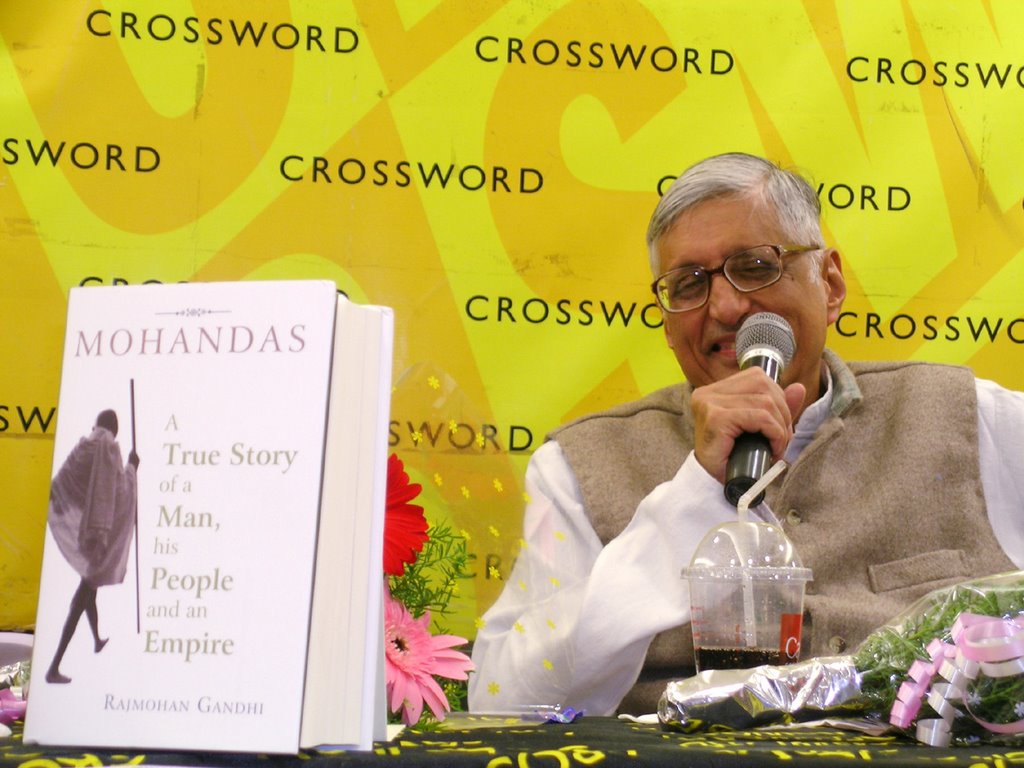
Photo by Omprakash
Book: Mohandas: A True Story of a Man, his People and an Empire
Author: Rajmohan Gandhi
Publication: Penguin Viking
Pages: 745
Price: Rs 650

Albert Einstein, one of the geniuses of the last century once said of Gandhi, “Generations to come will scarcely believe that such a one as this ever in flesh and blood, walked upon this earth.” On the close heels, much has been written and discussed about the life and times of Gandhi which has made him more or less a metaphor for non-violence, peace and humanity. But none of the biographers or writers have ever tried to discover the real man in Gandhi. If there were any attempts, they were eclipsed by his virtuosity and made them benumbed. Moreover, with the genre of writing biographies itself witnessing a change, Mohandas: A True Story of a Man, his People and an Empire conjures up the arena with its flamboyant details about the Mahatma, which were hitherto unknown.
Ranging from Erik Erikson’s Gandhi's Truth, which analysed Mohandas psychologically, to diaries of Gandhi’s personal secretary Mahadev Desai, all his biographical histories were either known for favoured treatment or deconstruction of Gandhi. Thus for anybody venturing to write yet another biography would be a herculean task, not content-wise but also in being true to the subject. Like all good batsmen who find gaps between the fielders and score runs, Rajmohan Gandhi has achieved an immaculate success with a ‘chronological, complete and candid portrayal’ — one in which ‘the whole life of the Mahatma could be looked at as one piece, and a touchable, comprehensible Gandhi brought out.’
In his attempt to construct a candid portrayal, he neither embellishes his work with historic factual details nor does he exaggerate any particular event but a perfect symmetry between both on a neutralist pitch. Spreading across 16 chapters, from his boyhood to his assassination, Rajmohan unfolds a verisimilitude and gravitated details meticulously chosen from ‘a mass of materials: letters, memoirs, diaries and published articles.’ The slow and elegant evolution of a timid and shy lad from the Saurashtra region to a remarkable leader in two different continents at first and gradually encompassing the whole world with his political and cultural philosophies which paved way for the emancipation of underprivileged across the world, is indeed a scintillating stroke.
Many times most of the biographies on Bapu were read to know more about the functioning of the Congress Party and internal disputes over the presidentship, dispute over the partition plan which mirrored his secular views, his confrontations with other national luminaries and of course, the assassination episode. Not divulging from the curious details, Rajmohan Gandhi with all punctual details appears to be an uninvolved observer. Being a twelve-and-a-half year old when Bapu was assassinated, Rajmohan has succeeded in recording both the parochial events important for any boy of that age and the political life coloured with the family life of Mahatma from either the archives or from his father’s words.
The biography hogged the limelight for the candid details about Gandhiji’s love towards Saraladevi which was omitted by other writers. Not much bewildered by the curiosity, like all other episodes, he treats Saraladevi episode but takes away the credit for bursting it. In fact, the episode goes eponymous with his wish to write a ‘complete and candid’ biography! Commenting about the communal clash during the partition plan, Rajmohan opines that it happened despite Gandhiji’s efforts to persuade people along with the leaders but not because of intermixing of politics with religion.
While recollecting some of the popular and familiar milestones too, Rajmohan strikes with his novel approach. Scrutinising the events from the point of view of people who were involved in the episode, he provides convincing background in the form of apt anecdotes from their diaries or personal letters. But the narration and the events smartly escapes the current debates and timely or momentary preoccupation with the Gandhigiri and attempts to remain within the self-imposed peripheries of Rajmohan Gandhi. The preface filled with open statements about the author’s disposition, well in fact becomes a prelude to the entire story and defends his attempt to retell the open story of the father of nation.
Admitting his attempt to embark on a challenging task, Rajmohan states, “I went for it in fear, praying that I might do some justice to the man and also to the truth. God only knows how far I have succeeded or failed.” But a reader having grasped the text would conclude that the author has done justice within his own limitations.

Tuesday, January 23, 2007

All the way from Italy


This photo, which I received as a forward, was something rare and unique as I intuit at least. Not everyone of us get to see this archived photo. If you are good at face reading and rich in memory then try it out. If you guess that this must have been the photo of either Demi Moore or Salma Hayek in their 20's, then you are really wrong and update your Beauty Quotient (BQ) and try once again as I will be giving only hints to identify her. She is in no way inferior to any of the Hollywood or Bollywood movie actresses. If not now, at least in this photograph. I think there must have been some fitness centres mulling over the diet and exercise pattern followed by her.
Born as Edvige Antonia Albina Maino, at a dusky Italian village Lusiana, the lady has toiled hard to make it to the list of world's most powerful women. Even at 60, the whirling political events, unexpected twists and controversies have not been able to douse her enthusiasm and has been a fear factor among our netas.
Hailing from a different cultural background and despite her father's vehement opposition to her marriage to one of our former Prime Ministers, today Albina Moino is a pivotal and influential personality in the country's political arena. She never have imagined that she would one day attain a status of 'Madam', and hear the stories of our mirthful democratic leaders. I hope now you must have got the clear picture about the lady. But I am Sorry I can't fetch you a electoral ticket from her party on your achievement!

Saturday, January 20, 2007

Brain F****** caller tunes

Breaking the monotony of urban lifestyle, few things which come and go in our life, would really bring in some amount of joy and refreshment. An abrupt meet with your school days friend, smile of a paper boy, lingering words like Tata-See you of your neighbourhood toddler, an unexpected call or scrap from your forgotten 'girl'friend, tasty food parcel from home, an appreciating 'Yelllow Card' from your boss, would definitely bring in some amount of renewed energy and palpable willingness to take new initiative.
Though I encounter such things once in a while, this one which I heard from my editor was something new and I must give him all credit for the nomenclature. I am a huge(I can't tell how huge)fan of Amir Khan and have his track Pehla Nasha... Pehla Dua... as my caller tune. It was almost common for my friends to dial up my number and listen to it. However they would message me before doing such things and suddenly put my cell on silent mode.


I've seen boys and girls giving miss calls to their loved ones some times the money minded too indulge in such activities. But few weeks back I was surprised to see around 4 to 5 missed calls to my mobile. To a guy like me who get only one are two(Max:4)calls in a day, it was strange to receive 5 missed calls that too from my editor. In the afternoon, not knowing my presence inside the office once again I got a call from the editor. Counting on the number of missed calls, I sensed something foul has happened and I was tutoring my mind to face the aftermaths. But before going to his cabin I did a complete re-check of all the supplement pages thinking I must have done some mistake.
Much to my amusement, later I was told that my caller tune was so mesmerising that it made him nostalgic and cherished some of the old memories. He told me that songs like this along with couple of other tracks could be classified under Brain F****** caller tune categories as they dig up our memories hidden or cremated under the lesser known folds of brain. I came back to my desk and discussed with few seniors. In the evening, huddling over a cup of coffee at the canteen we enlisted few such tunes. Not necessarily the meaning, but the action and apt time in which they were composed and sung are some of the details which evoke such kind of effects.

Wednesday, January 03, 2007

Adieu to procrastination on the threshold of New Year


Hi,
I admit that It's been a long time since i attended to my blog. Important transition at the work place, new responsibility and added expectation compelled us to involve more meticulously than our previous endeavours. Hence, I had hardly any time to come back and comment or to articulate my views on happenings.
A New Year 2007 is before us, unfolding wide range of challenges to be achieved. Regardless of obstacles both intentional and natural, nepotism, constant 'bucketing' by your competitors, I hope the genuine spirit within us would help in trailing the path of success.
Taking cue from my seniors at work, I have added regular blogging irrespective of the hurdles to the list of to be achieved resolutions. That implies adieu to procrastination. Hoping you all render good support in endorsing a cause and entertaining the fair traits of this humble boy.

Happy New Year -2007

Sunday, December 03, 2006


Prodigy delivers his best


Film: C/O Footpath
Cast: Master Kishan, B Jayashree, Tara, Shourab Shukla, Jackie Shroff and Sudeep.
Direction: Master Kishan


It was once said that "the child is the father of the man" and the world's youngest film director has lived up to those remarks through his debut C/O Footpath in terms of plan and execution. Mater Kishan's subject — slum children, who may succumb to poverty and illiteracy if not guided in a right way — creates magic as against the usual love formula. The meticulously handled complex story line, galaxy of mega stars and a moving screen play makes the movie more enjoyable and refreshing and thus justifies the Guinness Records' decision.
The story revolves around an orphan's struggle to join school and get education. The main character 'slummu' (Master Kishan) is a rag picker and challenged by the school going children, decides to join school and show that slum children are in no way inferior to others. But his wishes gets dented following bureaucratic policies and the social mobilisation about the rights of slum children is launched and Chief Minister (Jackie Shroff) enters the scene to solve the crisis and asks authorities to admit 'slummu' to school.
Despite a few technical glitches, the movie has been etched out collectively with great care and hard efforts. Cinematography loses its charm in emotional scenes due to long shots and dialogues look artificial at the children level. But the track, on which the movie take off, eclipses the abrasions. Ready references to President Kalam, Faraday and Edison inspires children to work hard and achieve their goal. B Jayashree, Tara, Sourab shukla and Jackie shroff shine in supportive roles.
The ready mix of social and emotional agony of a subversive class and their fight to avail rights, win accolades and deserves an appreciation.

— Niranjan N Kaggere

Tuesday, January 24, 2006

Celebrating unsung genre of celluloid

Niranjan N Kaggere

Ever since Lumiere Brothers invented Cinema, it has mesmerised everybody with its magical spell. Hardly we see people who don't come under the ambit of cinema. Everybody, ranging from a kid to old age people, throng to cinema halls. But the medium that has recorded many milestones has also recorded set backs which are eclipsed by the sheer popularity of the silver screen.
If anybody thinks that these movies fetch us only some sort of recreation, then our thinking is wrong. Movies being entertainers, they are educative too at the same time; unfolding the different facets of technology, topography, lifestyle etc. Extending into many genres such as documentaries, tele films, melodramas, children movies etc. the celluloid seems to be failed when it comes to the issue of children. As a result, if one could rummage through the history of cinema, it is puzzling to know that very few movies have dealt with the issues concerning children.
Believing in the 18th century say that 'child is the father of a man', we all know the importance of children in society. Childhood memories, lessons have inspired the bards, artists and many others over the centuries in creating master pieces in their respective fields. Pedagogical skills stress on the fact that children learn more cognitively than by teaching. Even many behavioural psychological surveys justify these skills. Movies with lot of fun, moral, adventure, suspense can bring about a change in the development of a child or at least it would influence one particular stage of his personality evolution process.
Accepting this attitude of children, even our education system has brought in many pleasing changes. With incoming of communication gadgets such as television, radio and computers into the class room, audio-visual way of teaching has become an effective way to reach the minds of children. And children movies, taking up the fabric of audio-visual teaching can weave many issues in profound manner and thus providing 'edutainment' to children.
At the backdrop of these issues, how about witnessing a festival of children movies in different languages? The idea seems to be refreshing and that's what the garden city saw during the last week like the yester years. For the past few months Bangalore seems to be basked in the glory of hosting some commercial festivities facilitating entrepreneurs, corporate in their competitive fields. But the events like children festival, as called by the people still appears to be incredible for the fact that the entire festival is conducted by private bodies without any government funding. But this doesn't mean that it was dictated by one central organisation. The entire on screen saga of unsung genre of celluloid was democratic with lot of like minded people pooling in their ideas, resource and contacts to make the event a grand success. The festival achieved its goal with least advertisement at the time when the city's streets were swaggering with the hoardings and posters of other festivities.
This years children's film festival conceptualisd around the theme, 'a joyride through films' brought as many as 30 movies of different Indian languages. Bangalore's children India, a nascent forum for children's films, educational and other allied activities was the mind behind the festival. It's not a cake walk as we all know to organise such a grandeous festival simultaneously at two cities. But the Children's India's initiative to bring about an awareness about the children movies and laudable coordination with children film makers of the country gave us pleasing results. A week long festival, witnessed the screening of nation's best children movies that have won accolades and awards at the national and international arena.
With the raging debate about the funding and creative flaws, the kannada film Industry was quiet successful in terms of its contribution to children cinema. Out of eight cinemas made in the last year, four of them have won many awards and were screened at all major film festivals around the world. 'A, AA, I, II' a kannada movie directed by N R Nanjunde Gowda was a big hit among many kannada movies that were screened at the festival. The movie highlighting the dichotomy between traditional and technological life hints at the different alternatives for children's learning process. Another kannada movie 'Pravaha', which was selected for Indian Panorama in 2004-05 was centred around the concept of globalisation and its aftermaths on our culture and tradition. Depicting a potter as an exemplary victim, the movie flashes light on poverty of village craftsmen and their miserable social life. The movies looks at the myth of globalisation through the eyes of thirteen year old son of the potter and brings out horrifying shadows of the much venerated concept. Directed by veteran actress of the Kannada cinema, Arathi, 'Mithayi Mane' is about the 'sweet illusions' of life. The entire story is based upon German fairy tale Hansel and Gretel and blending Indian puppet play with it to showcase the symmetry between the powerful and powerless and exploitation of children. What seems to be more interesting about the movies was its reconciliation of old and new forms of story telling. The novel technique introduced by the director juxtaposes the fairy tale and screenplay against a rural and urban milieu. The movie takes up the issue of a young girl who's has given false promises by an urban family. When the family fails miserably to keep up the promise, the girl takes up the task of reviewing the intricacies of human relationships and thus portraying the children-elder subtle relationship. In fact the movie has won the best children movie awarded by the State Government.
Movies from other languages were also not far behind in the race in depicting the children issues. 'Malli', directed by renowned cinematographer Santosh shivan was the much discussed movie. Apart from the movies revealing the psychological and social side of children issues, there were also some movies with the use of graphics and imaginary characters to spur creative talent among children.
Looking at the contemporary situation when there is a void, kept open to fill, created by a lack of good children movies, efforts like these would bring more satisfaction. In many situations children's films do not have theatre screenings owing to different reasons. But film festivals are the great platforms in trying to open up the child's horizon. But many people say that it is not easy to find a formula for a better children film. It's true to a certain extent but a good film with all its accolades at many stages need not translate into commercial success. Many elements need to be woven into the storyline and at the final level it should touch the child's heart. That's what most of the movies did during the week long festival. As Ellen kelly, a Sweedish writer, puts up" at every step the child should be allowed to meet the real experiences of life; the thorns should never be plucked from his roses." Let us welcome this attitude in bringing about a change in our children's better performance.